Showing posts with label BIS. Show all posts

ISI no more Mandatory, affected segment : 2 = Consumers

It's consumers who ultimately drink the bottled water. How will the decision to make ISI voluntary, affect this segment ?

The consumers are divided into 3 sub-segments :-

Those who directly buy it from a shop & drink :-

These are travellers mainly who buy bottles from open market. They just say/call it "Bisleri" and just know that it's bottled water. Most of them are not even aware that there is something called ISI. At the most, if they know or made aware that it's licensed through fssai, it should be sufficient for them. 

Those who buy it at a cafe/restaurant/hotel :-

These people too, don't know actually whether bottled water needs ISI ( majority of them ). They can also be made aware. Not much effect.

Those who don't buy, but drink it inside their work-place/event etc.

Unless the host is particular, there won't be any resistance from consumers. 

20 Ltr Jar buyers who consume water on monthly basis, mainly corporates/ institutions 

There is more chance that these consumers will insist for ISI ( at least 50% of them ). Logic : NoπŸ˜‡

The "Cold-Jar" water consumers

There is no difference, and the suiers of such water are expected to negatively use this govt decision.

What Happens to the actual quality of water supplied in light of this decision ?

If the producers, thmselves are particular about providing the best water, ISI cost is negligible. And the quality will continue to be delivered In absence of the Mandatory tag , the quality will certainly detoriate. 


ISI no more Mandatory, affected segment : 1 = BIS license holders

The recent notification to lift the "compulsory" ISI mark to run a Packaged Drinking & Natural Mineral Water Units have posed many questions in front of the existing license holders. However, every obstacle opens up way to a new solution. Let's try to contemplate here.

Ambiguity : The special, protected market gone kya ?

The consumers, especially the corporates etc, rely on the "ISI" license of the producer. Once they see this, and don't see that, their first screening is done. Now, it's expected that many of the plants will opt out of the licensing. Is this viewed as a threat or emergence of a special market ? 

My view :-

The corporates which truly care the hygiene etc, will still stay with the "ISI" holders. Those who just care for the compliance will go to others as well.

How to compete here ?

Staying with the BIS license, and stringently follow the tests. Use it as a brand. Also educate your audience through self publication, through social media & newsletters.You can bid for marginally higher prices, and can reason it out as well. Slowly, market, brand gets developed, and you may earn a solid reputation.

Build relation with the "consumers" not just distributors. Built a list of consumers of your water. Share coupons, with them through whatsapp, and share brand news about your company. Something like "loyalty List" can be very very handy.

Show how BIS compliant plant protects their hygiene. As stated in point no.1, share exactly how you meet the standards mentioned & why they are in place. It assures them their hygiene.

As time passes by many updates will appear. Let's watch. But welcome the change with a belief that it will bring a positive change.

BIS is no more mandatory for Packaged Drinking Water : Effects

With the recent Gazzeteer notification, it's very clear, that, within India, anyone willing to sell Packaged Drinking Water, will not be needing ISI mark, as it was mandatory, earlier. At present, there are 2 licenses needed, 1. The fssai & 2. The ISI ( Issued by the BIS ). With immediate effect, this will come into force.

😐Yes, you heard it right : Anyone willing to start his own production unit for Packaged Drinking Water, he won't need the BIS certified ISI mark. 

However, if somebody wants to take it, it can be taken as an added certification.

What can be the possible broad effects of this ?

For existing license holders :-

  • They will loose the sort of monopoly, as many new entrepreneurs will enter this zone.
  • They will need to find ways to prove their water's real worth
  • BIS certification will have its true value, not just a "license"

For new entrants :-

  • Big entry barrier gone
  • Scope for more creativity
  • More flexibility

Things are not as smooth as they look like 

  • It will take some time for the fssai to make its own set of rules, however, it is more likely that they will follow BIS's ways in many procedures, but upto certain time-limit.
  • BIS has a Scheme of Testing, through which, adeltration was automatically protected. Now, without BIS, how can this be protected ?
  • There is likelihood of getting several complaints, at least till it gets stabilized.
  • Fssai will replace BIS, things don't change much : That's what business owners expect.
  • There is not enough strength of auditors/officers with the fssai; how can there be new licenses issued ?
I have listed down hardly a few challenges. The Association of All india PDW manufacturers has requested the fssai to re-visit the decision ( however, it won't be taken back ) & make certain amends in it. Let's see. Only time will tell the story.

This : Clauses 17 & 18 are omitted now.πŸ‘‡


The earlier Regulation said it is necessary :πŸ‘‡


New fssai new Rule : Who are the real targets ?

The Background :-

The fssai, has come out with a new rule that every Packaged Drinking Water producer must add minimum  amount of calcium & magnesium in their produce. The limits have been specified by them like 20-75 mg/ltr for calcium & 10 to 30 mg/ltr for magnesium. The highlights of this rule are :-
  • These rules are made after the push of NGT (National Green Tribunal) in 2019.
  • This is the 4th & final extension given to all Packaged Drinking Producers.
  • This has to be implemented from January 1, 2021.
  • All majors (the Brands) are said to be ready, which contribute to almost 60% of the market share still 

There are certain questions came to my mind ....

Whom are they targeting exactly ?


I have observed everytime, when a rule is created, its to target some particular segment within the sector itself. The key issues are identified, and , with the help of certain associations & govt bodies, these issues are identified. Then the action is formed & implemented.

What may be the key issue here ?


If it is the Water Quality (retention of minerals), then why the BIS doesn't make it compulsory. The BIS is the main licensing authority. There are 6000 + units all across India who possess a BIS license, and it's mandatory & fairly descriptive that fssai compliance. 

Is it to get more units registered with fssai ? The fssai license is also a compulsory thing in addition to the BIS. However, many units (almost75%) do not possess an fssai license. These all are from the inorganized sector- the nobrands. Is it to get them under fssai ?

Is it to just satisfy the Green Tribunal ? As mentioned in point 2, if it was that serious, they would really make amends in the BIS rules. However, there is no news from them. The NGT has been shouting quite a loud from last couple of years. Is it just to give them some consolation ? 

Shall we be observing a Price Hike ? The Packaged Drinking Water Bottle MRP looks to be settled at Rs.20 , quite for some time now. Is there an overall, well justified plan to take it to Rs.25 or Rs.30 ? The Industry has incurred some major losses during the Covid-19 period & has been reporting these losses. Is it an all-industry combined action-plan to justify the "would-be" price hike ?

Reduce the "Duplicators" ?

This is an other challenged by this industry, if more rules are imposed, there will be lesser people who may dare to duplicate without license.

WHO connected guidelines

Has WHO issued more guidelines after Covid in particular ? This rule may be in line with implementing them.

Favoring the NMW

NMW means the Natural Mineral Water segment. It has rich content of minerals, naturally. The price is like heaven for these bottles. Right from the Himalayan to the Veen, these waters are heavily charged, almost 5-10 times than them. This rule benefits them, that's for sure.

Points to make ...


  1. The rule seems to be good/ok. However, challenge is the implementation. The inorganized sector doesn't seem to care about the basic value principle of this industry : Offering Hygiene. To really make them aware on their principle value is a major thing. 
  2. Who are those "purifying companies" which Bisleri says, who are doing excessive filtration ? If we observe all packaged Water companies (bisleri & others) have a TDS count of 30-72 for final water. And they too implement the RO process, which itself setup to remove the TDS - Total Dissolved solids from the source water.
  3. A technical point : There are many other minerals, with which the water quality is observed. Just increasing the Calcium & Magnesium ....will it balance the Water Quality ?

Conclusion

Let's welcome the rule, as it is created after numerous amends from time to time, after being reviewed by several scientists, industry experts. With a very clear & assertive mindset, we should always look at the positive outcomes of the rule. That's an assertive thought.

10 Points to observe water quality in a Packaged Drinking Water Plant

Water Quality in a Packaged Drinking Water Plant

There are 2 prominent reasons why Packaged Drinking Water is consumed :

  1. Convenience while in transit
  2. Uniform quality irrespective of the place you go to.
However, point no2 is discussed below. There is a Govt Body, the B.I.S. which has made it mandatory to every Packaged Drinking Producer to get the ISI license under standard IS - 14543. And there are also set norms through detailed documentation on how every production unit needs to maintain uniform quality standards.


Point No1 : Follow the Hygienic Standards as per the IS : 14543

In a Packaged Drinking Water Plant, usually, the raw water source is the Borewell Water. The Water Treatment section, with the help of the R.O. Unit, removes nearly all the Minerals from the raw water & adds back the required ones in necessary dosage. These added minerals should be within the prescribed limits defined by the B.I.S. as per the Standard allotted IS-14543. Following & respecting the process is the 1st most important point.

(Video Stamp :- 00:12)

Point No.2 :- Understand "Why" there is a need for consistent monitoring

The Raw water , which comes from ground water is sourced from the aquifers. This quality might change from time to time. This might affect the treatment required for the raw water. Hence it needs a consistent monitoring at various stages on a regular basis, as specified by the B.I.S.

( Video Stamp :- 00:41)

Point No.3 :-  Follow the B.I.S. Testing schedule

The B.I.S. has cheated a schedule for testing water. Some tests are 4 hourly, some of them are daily, weekly, monthly etc. Following the schedules as a ritual is the key to quality. 

(Video Stamp :- 01:17)

Point No.4 :- Have it all within the Plant itself

B.I.S. has laid down the complete document on its website about the hygienic standards to be followed. It has to be maintained WITHIN the plant itself.

(Video Stamp :- 02:11)

Point No.5 :- Have in house Quality Personnel to maintain it 

The B.I.S. has specified 2 separate laboratories : One for Chemical Parameters & One for Microbiological Parameters. These departments are looked after by 2 quality Chemists.

(Video Stamp :- 02:41)

Point No.6 :- Maintain the Labs Properly 

The labs should be exactly as per the specified document by IS 14543. Outside labs for daily testing is not allowed. However, certain reports on annual basis & monthly basis are still required from an outside BIS approved lab; but the regular ones from the In-House lab itself. In the hygienic Requiremement, there is a full list of Glassware & Chemicals given.

(Video Stamp :- 03:08)

Point No.7 :- Maintain the Parameters

As the raw water quality changes from time & season, thus the quantum of added minerals if any. However, as mentioned earlier, play within the limits & maintain the records.

( Video Stamp :- 03:32)

Point No.8 :- Be prepared for surprise visits

If you maintain all books & records as per the B.I.S. specifications, you will hardly need to worry about surprise visits. However, you will need to keep a close look at all the departments through diplomatic HR policies etc.

(Video Stamp :- 04:03)

Point No.9 :- Observe your Distribution as well

If BIS finds you faulty samples from any of your Point of Sale (POS) places, without delay they will place a "STOP" mark , meaning you can't start production until it's cleared off. Hence it's not just important to maintain quality at your factory, but also at the POS.

(Video Stamp :- 04:23)

Point No.10 :- Follow fssai rules strictly

Besides the ISI license, the producers also need to maintain the fssai license. Please see to it, observe their rules, schedule & renewals properly. This is also a key quality hack.

(Video Stamp :- 05:22)

These 10 points will cover most of the quality hacks for a Hygienic Packaged Drinking Water Plant.

If you have some question/ something valuable to share, please reply in the comment section. Thanks

How to get ISI Number for Bottled Water ?

(All your questions pertaining to the ISI Licence for Bottled Water in India or B.I.S. are answered, the content is continuously updated)

Why do we need an ISI Number for Bottled Water ?

ISI is issued by the B.I.S. Once you get a valid ISI Number from them, you can mark your labels with the ISI Number , which enables you to officially sell your water within India. 

Without ISI, can't anybody use water ?


For usage, you don't need ISI, e.g. if you consume the treated water in your own premise for own consumption, it comes into picture when you decide to "Sell" the same.

Where do we apply for getting an ISI number ?


As mentioned above , the ISI Number is given by the B.I.S. They have a setup procedure, which can be followed from the website from this link

Is it easy to get an ISI License ?


It's simple, but not easy. You have to observe certain norms to get the ISI Number. Like the Location, Water Source, Neighbourhood, Layout, Quality Assessment etc. It is a step by step procedure to be followed.

Well, How much time it takes to get it ?


As per laws, you should have all the required machinery in place before getting the same. Once this is done, the ISI officials visit your factory & issue license if and until they find everything in order as per the standars (IS 14543 for Packaged Drinking Water and 13428 for Natural Mineral Water). Usually you should be getting it within 2-3 months depending upon the availability of the personnel.

Does this require any fees ?


BIS charges a "Marking" Fee, to mark your bottles with the ISI Number provided. Annually they charge Rs. 1,28,000 ( Check Latest Fees Here), to be renewed every year.

How strict are they ?


It is important to follow all the gudelines properly, ISI officers have authority to pick up any bottle from any sales counter, check it in their labs, and post a "STOP" marking, in case they find it doesn't confirm to the exact standards. This may put a temporary break on your business.

How does a plant observe the procedures ?


Every Plant has to follow a procedure, with in house Labs and supported by Technicians. There are record to be maintained every day, week, month. The BIS officers have authority to visit your factory anytime.

Can I buy water from an ISI approved plant in bulk & sell with repacked in 1 Ltr Bottles ?


Yes. This is possible. However, you can't transport the water to other location. You need to pack at the manufacturer's premise only and re-Label the same. The label will have both the names. Yours as "Marketed by" and ISI holder's as the License holder.

If I don't make Bottles, and just make 20 Ltr Jars, still I need ISI ?


You need ISI License whenever you are selling packaged water in any & every form. Be it Pouch, Bottle or 20 Ltr Jars. And the expense (Fees) is same. Cool Jar doesn't come under ISI.

Can I Pack 5 Ltr Jar, 20 Ltr Jar in the same Plant ?


Not only this, but your same plant can pack all varieties of packing in a single plant. Even all shapes (even if you have different kinds of bottle shapes & designs) of packing can be done from the same plant.


Is Your Bottled Water Original ?

How to Check the Water Bottle if it's Original ?

Packaged Drinking Water Bottles are bought on the go from shops. However, while paying Rs. 20, how can we know for sure that it's original ? Here are a few ways :-

1. Check if the ISI mark is dominantly mentioned on the Bottle Label First. 


ISI Mark is issued by the BIS, You can also check whether the licence is upto date/Expired/Not renewed etc 


STOP Marking meaning the quality of water has certain issue & the said firm is said to STOP marking the ISI Number on the label.

2) Check the fssai details : Besides the ISI Mark, the producer should also obtain a valid fssai license. It is also mandatory for some agency getting it packed from some other producer

Bottle Showing Both Details : ISI & fssai

You can also check the status of the fssai License as well :-


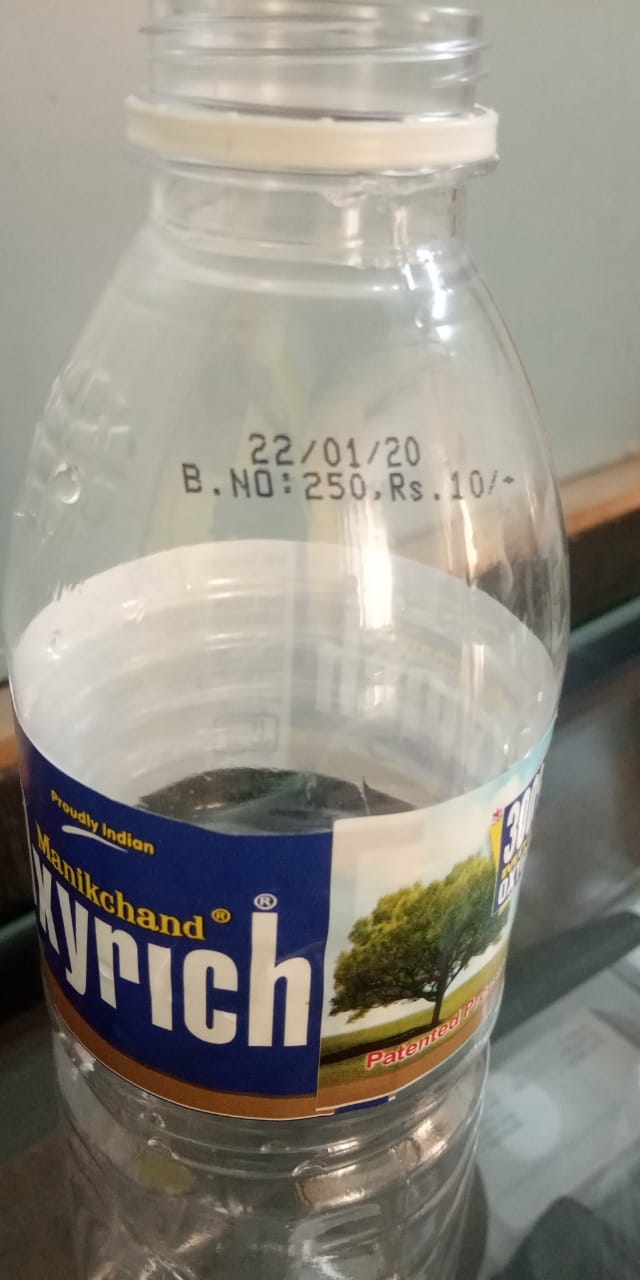
3) Finally , Check the Batch No & Packing Details on the Neck :-


If you see any discrepancy, please call up the customer care number of the said company & inform them about it. Many a times, the firms might have paid all dues , but the websites do not reflect that. And even if still a problem remains, then you may make suitable complaints.


Most Recent Post

Working Capital :- Please Spend Time on This

Enormous number of businesses fail here : Not knowing Finance. And believe me, it's not that complex as we think. I too, am not a Financ...